Natural gas is the obvious alternative to the Susitna Dam since gas already provides the great majority of electricity to the region that the dam would serve, and at low cost. Natural gas in Alaska does not require fracking; it is burned off in huge flares because it’s so readily available. The State of Alaska justified the dam by saying that natural gas was running out. In fact, as the State now admits, now that the dam is on the fast-track, supplies of natural gas are so enormous that only a shift in political desire from dam to gas is required to continue tapping the gas. Natural gas provides not just the majority of the electricity but also the majority of heat. Alaska, especially in winter, does need heat. Lots of it. Which means gas must continue to be developed regardless of whether the dam is built or not. So it may seem ridiculous that an expensive, destructive dam that only provides electricity is being proposed when natural gas, that’s already here, that already meets both needs, has less organized support in the Alaska state legislature.
But even Alaska gas isn’t “clean.” In fact the effects of the dam will pollute an entire ecosystem; natural gas would have far less impacts. But gas isn’t “renewable.” In fact gas would provide the bridge to other sources of electricity that are in development, that are both cleaner and more sustainable for longer than even the most massive dam.
There are five types of “renewable” energy available in Alaska besides hydro. Those sources are:

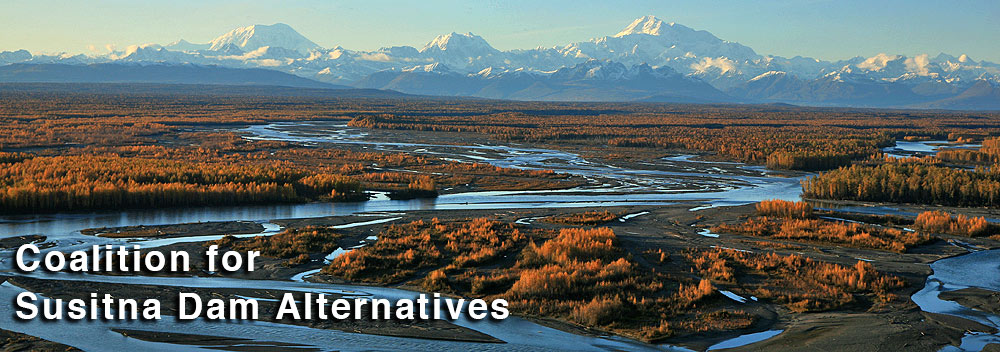
Susitna River sunset
1) Tidal. Ocean Renewable Power Company is readying a pilot project in Cook Inlet to produce an initial 5 MW of electricity. Alaska possesses 90% of the country’s total tidal power potential, estimated at 125,00 megawatts. When the technology becomes viable in ten or twenty years (the dam wouldn’t be ready for twelve), all Alaska could be powered by it.
2) Geothermal. Ormat Technologies, Inc. has begun exploration of the vast geothermal potential in the volcanoes across Cook Inlet from Anchorage. Geothermal now powers most of Iceland.
3) Wind. The first two Alaskan wind farms will be completed in 2012 or 2013. On an island offshore of Anchorage, 18 Megawatts will be produced with a capacity for 54 MW. On a bluff near Fairbanks will be a 24 MW facility. If six or seven more wind farms were built, the electrical output would equal the dam’s output at a total cost of 1.5 billion rather than at least 5 or 6 billion for the dam.
4) Solar. Battery storage for solar electricity is a technology that still is unable to hold large amounts at little cost. But amidst 24-hour summer sun, solar power in Alaska will inevitably become part of a state-wide energy plan.
5) Energy efficiency. Though not as sexy as big industrial projects, even the State of Alaska recognizes that energy efficiency programs are mandatory. Saving electricity is not producing electricity, but up to 300 MW- the amount the dam would produce- could be “added” to electrical availability through energy efficiency. A 2010 Railbelt Electric Efficiency Landscape report states that, “A 50% improvement in the Railbelt’s electricity efficiency could generate an increase of up to $947,992,100 in economic output and $53,499,850 in business income. It would also create an astounding estimated 9,350 new jobs.” The “Railbelt” is the region from Fairbanks south through Anchorage with the same 75% of the state’s population that the Susitna Dam would serve.

Susitna River Valley fall
In 2011 the current State administration announced a policy goal of “50% Renewable Energy by 2025.” Soon after, the Susitna Dam project was announced as the only way to meet that goal. Clearly, there are many other ways. The administration’s only other justification for the Susitna Dam is that natural gas fields are politically complicated to keep tapping.
So why isn’t the State pursuing the expansion of Cook Inlet fields? Politics. Bad politics. Natural gas leases in Cook Inlet are now owned by oil companies who sell it to the state just as they sell petroleum; thus the price of natural gas will inevitably go up, making “free water” from hydro attractive. The price of natural gas is now so low that oil companies don’t see a profit in further Cook Inlet development: checkmate, a political gridlock. The obvious way for the State to recover that gas is not to be dependent on oil companies but to develop those fields itself, exactly as the State is proposing to develop a state-owned dam. Anchorage’s publicly-owned electric utility has already purchased a share of ownership in the Cook Inlet gas field, to the ratepayers’ benefit. So it is just a matter of political will for the State of Alaska to establish a publicly owned Cook Inlet gas utility. The gas is there. As “free” in cost to the State as water.
The Susitna Dam twelve miles from Watana Creek, called by some the “Wa-Su,” has so many better alternatives that taking it up the wa-su is not just unnecessary, but a travesty. It’s worth noting, too, that the dam is actually proposed to be at Deadman Creek, not Watana. But The Deadman Dam was not a name the state liked, either.
(next page: Dam Problems)
